
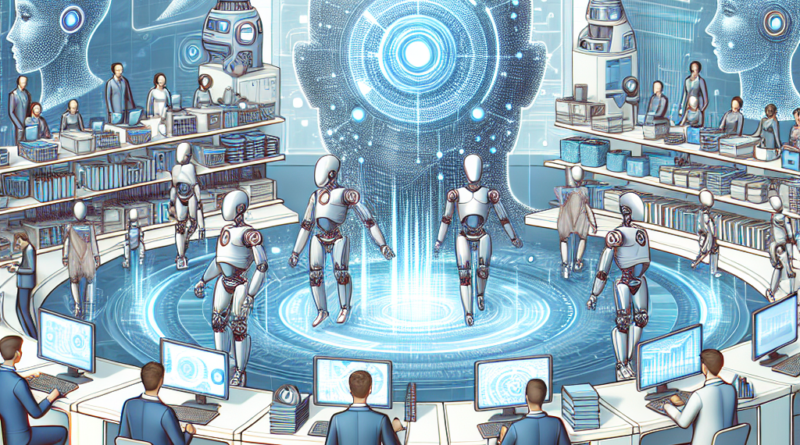
Anthropic created a test marketplace for agent-on-agent commerce
Anthropic Unveils Groundbreaking Test Marketplace for Agent-on-Agent Commerce
The frontier of artificial intelligence continues to expand, as demonstrated by Anthropic’s latest initiative: a test marketplace tailored for agent-on-agent commerce. This innovative project reflects an emergent trend where AI agents not only interact with human users but also engage in transactions with each other. Achieving this milestone opens a slew of possibilities and challenges within the digital economy.
Gleaning the concept from anthropomorphic business interactions, this marketplace is a closed system designed to assess how AI agents manage commercial tasks autonomously. By creating a controlled environment, Anthropic intends to evaluate and refine the mechanisms behind autonomous commerce, thereby addressing questions about efficiency, security, and decision-making processes without human intervention.
The introduction of this test marketplace is a strategic move by Anthropic, one that’s significant for both the company and the broader field of AI. It paves the way for developing sophisticated, self-sufficient agents capable of handling dynamic tasks that extend beyond static commands or predefined responses. This, in turn, pushes artificial intelligence closer to the concept of a self-sustaining, autonomous economy.
A fundamental aspect of Anthropic’s marketplace is its focus on agent interactions as complex decision-making processes. Unlike traditional e-commerce platforms where transactions are orchestrated by humans, here AI agents negotiate, strategize, and execute transactional activities based on algorithms and learned experiences. This involves resource allocation, price setting, contractual negotiations, supply chain management, and potentially even customer service, albeit interactions are completely digital and involve no human customers—as yet.
Anthropic has designed this experiment with a vision of future applications where AI agents can manage segment-heavy operations like supply chains with enhanced precision and minimal human oversight. Imagine logistics systems where delivery drones autonomously reorder parts from suppliers based on predictive algorithms or virtual markets where software could request server space or bandwidth in real-time, based on demand fluctuation analyses.
However, the introduction of such autonomous systems isn’t free of challenges and risks. Key among them are issues of security and trust. Allowing AI agents to handle sensitive data and execute financial transactions inevitably raises questions about data protection and potential vulnerability to cyber-attacks. Anthropic is addressing these concerns by employing robust encryption protocols, rigorous safety nets, and continually training their agents using advanced Generative Adversarial Networks (GANs) to simulate potential threats and defenses.
Another pressing question is around ethics and regulation. As AI agents make decisions independent of direct human oversight, how they are instructed morally and regulated legally becomes crucial. Anthropic collaborates with policymakers, ethicists, and industry leaders to develop frameworks that ensure technology is utilized responsibly, aligning with societal values and norms while preventing misuse.
Anthropic’s test marketplace is still in its nascency, designed for internal testing and development. However, it serves as a prototype for what might be possible in public applications, assuring a future timeline where autonomous marketplaces are not mere figments of imagination but real, functioning entities within the digital ecosystem. Beyond commerce, such agent-on-agent interaction models might extend to sectors like healthcare, urban management, or environmental monitoring, solving intricate problems by decentralizing decision-making authority among intelligent systems.
Through this initiative, Anthropic extends the conversation on the seamless integration of AI in routine economic activities, showcasing how technology can be leveraged for more efficient and driven outcomes. As industries eye digital transformation strategies, agent-on-agent commerce models represent a cornerstone of ongoing conversation, reminding us of the importance of innovation in driving forward economic and technological changes, and ultimately, shaping the future of global commerce.
In conclusion, Anthropic’s test marketplace for agent-on-agent commerce not only signifies a pivotal step in AI evolution but also marks the beginning of a broader exploration into the capabilities of autonomous systems. As we stand on the cusp of this new era, the world watches closely, eager to see how these digital ‘agents’ harmonize with human ingenuity to revolutionize industry landscapes everywhere.